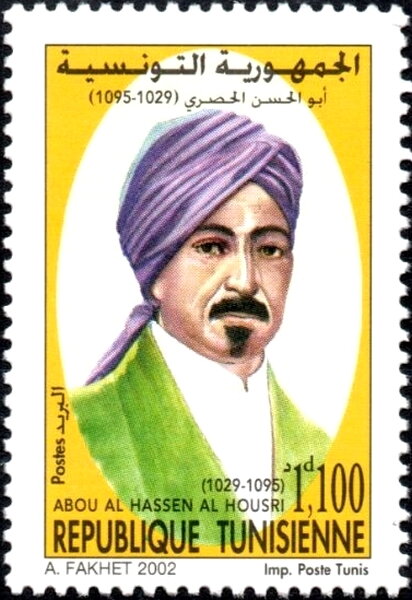
Abu Al Hassan Al Housri
Michel Reference
TN 1539
Stanley Reference
TN 1519
Yvert Reference
TN 1464
Themes
personalities
Description
Abou al-Hassan al-Housri, real name Abou al-Hassan Ali Ibn Abdelghani al-Fehri, born in 1029 in Kairouan and died in 1095 in Tangier, is an Ifriqiyan poet.
A descendant of the lineage of the Quraych and Oqba Ibn Nafi al-Fihri[1], he was born in Kairouan in 1029 (i.e. 420 in the Muslim calendar). Nicknamed al-Housri, that is to say manufacturer or seller of carpets (husur)[2], he is the cousin through his mother of the poet Abou Ishak al-Housri, also a native of Kairouan[3]. His mother died when he was young and, as he was blind, his father helped him study the Koran, hadith, fiqh and literature. Mastering the Arabic language and poetic art, he became a teacher in Kairouan and, when his father died, he wrote a poem about the sadness and pain he felt then.
After the Hilalian invasion, he chose in 1057 or 1058 (i.e. 449 in the Muslim calendar) to migrate to Ceuta and taught there for more than ten years. He then went to Andalusia and became famous as a poet in the courts of the sovereigns of the time: he went to Seville in 1069 or 1070 (i.e. 462 in the Muslim calendar), then to Malaga, Almería Dénia, Valencia and Murcia. Jealous, he fell victim to court intrigues and, in 1090, left for Tangier where he died in 1095 (or 488 in the Muslim calendar).
A descendant of the lineage of the Quraych and Oqba Ibn Nafi al-Fihri[1], he was born in Kairouan in 1029 (i.e. 420 in the Muslim calendar). Nicknamed al-Housri, that is to say manufacturer or seller of carpets (husur)[2], he is the cousin through his mother of the poet Abou Ishak al-Housri, also a native of Kairouan[3]. His mother died when he was young and, as he was blind, his father helped him study the Koran, hadith, fiqh and literature. Mastering the Arabic language and poetic art, he became a teacher in Kairouan and, when his father died, he wrote a poem about the sadness and pain he felt then.
After the Hilalian invasion, he chose in 1057 or 1058 (i.e. 449 in the Muslim calendar) to migrate to Ceuta and taught there for more than ten years. He then went to Andalusia and became famous as a poet in the courts of the sovereigns of the time: he went to Seville in 1069 or 1070 (i.e. 462 in the Muslim calendar), then to Malaga, Almería Dénia, Valencia and Murcia. Jealous, he fell victim to court intrigues and, in 1090, left for Tangier where he died in 1095 (or 488 in the Muslim calendar).
Size
28x41 mm
Colors
Polychrome
Designer
Ali Fakhet
Printers
Tunisia Post Printing House
Perforation
13
Print
Offset
Face Value
1,10 DT
Mint Value
2,89 $
Used Value
0,58 $
Manage this stamp
Log in
or create an account to add this stamp to your collection!
This page was viewed 377 times